Women of the Archives: Educators, Activists, Influencers
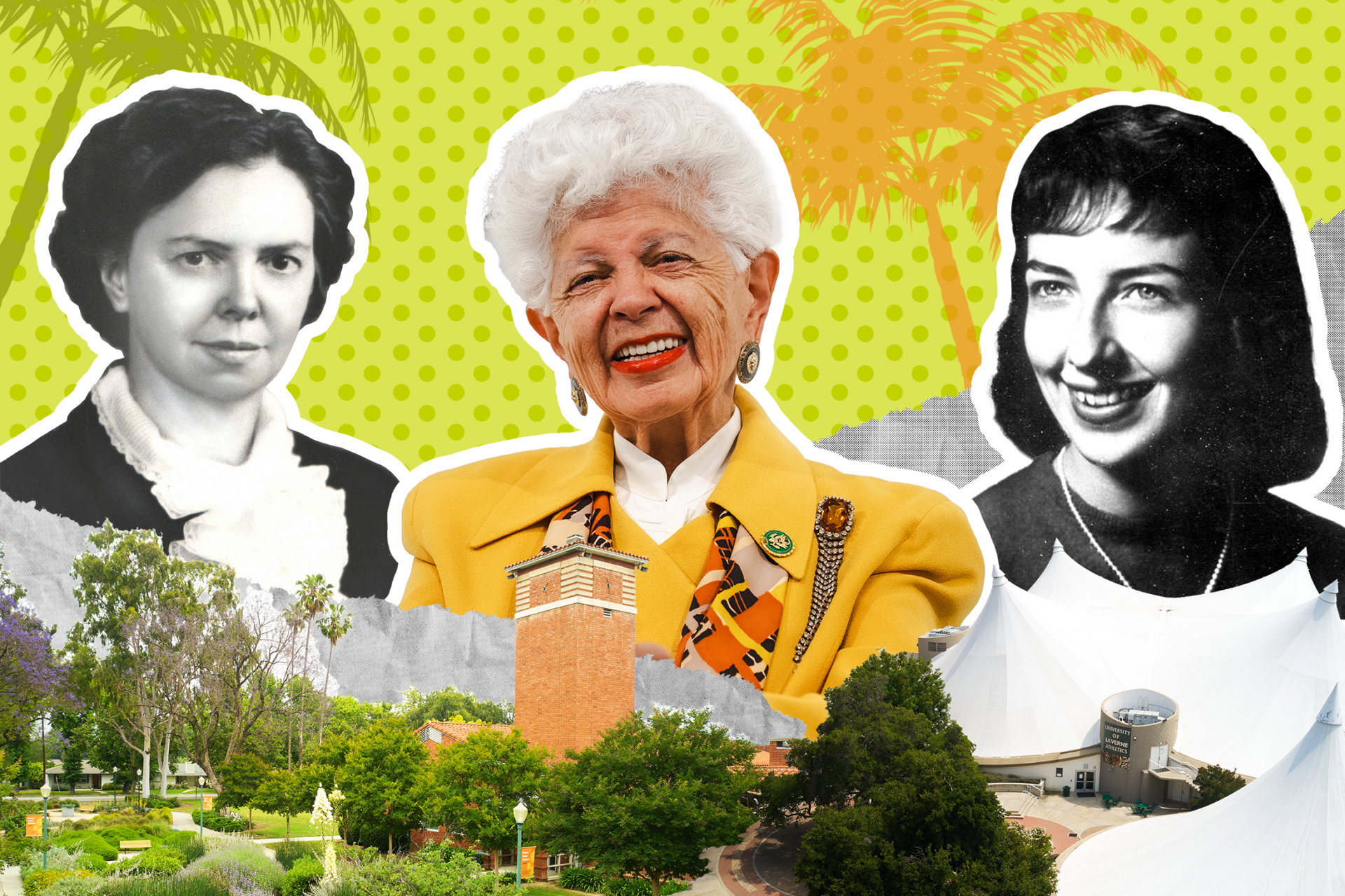
Gladdys Muir, Grace Napolitano and June Pulcini, three influential women whose archives are preserved at ULV. (ULV Graphic/Alycia Watt)
Through the university’s archives, the lives of Gladdys Muir, Grace Napolitano and June Pulcini reveal enduring legacies of scholarship, service, and public leadership
By Keren Darancette, ULV archivist
When asked to spotlight an influential woman from our archives, it was too hard for me to pick just one. So in honor of Women’s History Month, I’d like to spotlight three women I’ve come to know through our archives that I deeply admire.
Gladdys Muir began her career at Lordsburg College as a professor of Latin and Spanish in 1916 at the age of twenty-one. Five years later in 1921, Muir changed her direction to become a professor of history. Over the next twenty-six years in that role, she helped to form the history department at La Verne College, and wrote her seminal work, “The Settlement of the Brethren on the Pacific Slope.” In 1948 she left La Verne for Manchester University where she created a Peace Studies Program. Muir was well known not only for her intellectual abilities but for her strong spirituality and bond with her students. Muir’s teaching journey ended where it began when she returned to La Verne in 1959 to resume her teaching position part time. Reportedly on her way to the bookstore in 1967, Muir took a spill down the steep Founder’s Hall steps, sustaining a head injury that she later died from at Pomona Valley Hospital. Muir is still with us today in the Wilson Library, honored with some of her original art hanging on the north wall, as well as multiple boxes of the University Collection known as the “Muir Papers.” A good portion of these have been digitized and can be currently found on JSTOR.
Grace Napolitano began her career at Ford Motor Company as a working mother raising five children. After retiring from Ford, she made her way into city politics, first with the City Council of Norwalk then onto becoming the mayor. Finding her niche in the work, she ran for CaliforniaAssembly member, and won, claiming a seat for six years. The next logical step was U.S. Representative, which she ran for in 1999 and won, beginning a twenty-six-year service as a Democratic member of the U.S. House of Representatives. During her career Napolitano made great strides in her four main causes: water, transportation, mental health, and Latino issues. She fought to restore water rights to Indigenous people, to increase access to public transit, and to bring to light mental health issues in America, helping to write legislation that made it mandatory to include mental health in insurance coverage. Napolitano’s archives were donated to La Verne in late 2024 and displays can currently be found on the first floor of the Wilson Library. In addition to select digitized materials, her full archives on the third floor can be seen during drop-in hours or by appointment.
June Pulcini graduated from La Verne College in 1962. One year later June and her husband Ronald (class of ’63), joined the International Volunteer Services (IVS) to serve as volunteers in Cambodia in September of 1963. Devout in her Brethren roots, Pulicini valued pacifism, and the IVS offered an alternative to a mandatory military draft for Ronald. After two years the program dismantled and Pulcini relocated to Vietnam. When the US bombed Vietnam in 1965 the Pulcinis were forced to evacuate. They moved to Laos and Ron continued to serve South Asia with various agencies including USAID and the USIS Bi-National Program while June continued to teach English and fourth grade at the American School. After her return to the US in 1970, Pulcini continued a lifetime of participation in projects and initiatives to promote peace, human rights, and to end violence in South Asia. The June Pulcini Collection was first processed in the archives in 2012, with additional materials currently underway.
These women’s lives may have been separated by geography and time, but the thread that ties them together is how they changed the lives of those around them through perseverance, deep commitment to their causes, and a longing for peace, justice, and well-being for all. We are honored to hold their legacy here in the university’s archives. Happy Women’s History Month!