Studying Water, Strengthening Communities
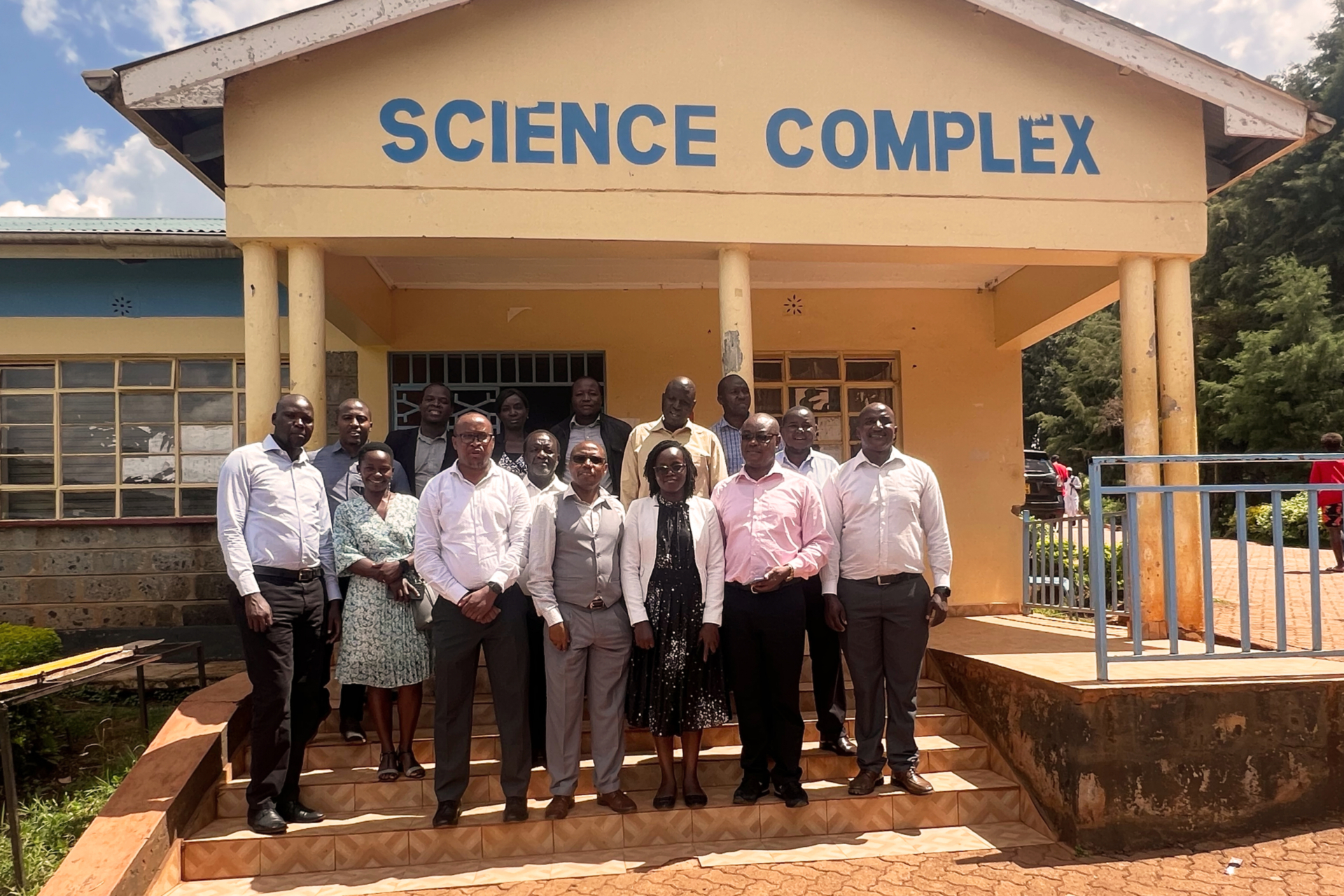
Professor Nixon Mwebi, center, collaborated with researchers in Kenya while studying water quality in the Nyakomisaro River. (Courtesy of Nixon Mwebi/Mark Nelson)
A River’s Story: Chemistry, Community, and the Quest for Safe Water in Kenya
At first glance, the Nyakomisaro River looks like any other waterway winding through a growing city. But for thousands of residents in Kisii Town, Kenya, it is far more than scenery. It is their primary source of water, a dailynecessity, and increasingly a growing concern. For Professor Nixon Mwebi, chair of the Department of Chemistry at the University of La Verne, it is also a scientific mission rooted in both expertise and personal history.
Mwebi recently returned to his native Kenya to study the Nyakomisaro River, a waterway critical to the lives of 80,000 residents in Kisii Town. Only about one in four people has access to piped water. The rest rely on rivers, wells, or collected rainwater. “That creek is very important to the population,” Mwebi said. “Somebody has to look at it.”
His path to Kisii is personal as well as professional. Born in southwestern Kenya near Lake Victoria, Mwebi earned his bachelor’s degree in chemistry at Kenyatta University before moving to the United States for graduate school. “Kenya cooked me, and America spiced me up,” he said with a smile. Years later, armed with expertise in environmental chemistry and a Carnegie African Diaspora Fellowship, Mwebi returned to collaborate with local scientists and students, bringing international resources to tackle a local problem.
The study examined ten points along the river, from sparsely populated upstream stretches to busy urban sections where the river collects the city’s runoff. The results were startling. While basic chemicals, such as nitrates, fell within safe ranges, the water was extremely cloudy and full of suspended particles, far above safe levels for drinking. This cloudiness, combined with household waste, farm runoff, and city debris, makes the water unsafe without treatment.
“Our analysis revealed a serious problem,” Mwebi said. “Even if some of the nutrients may not have exceeded allowable limits, the combination of waste and cloudiness makes this water unsafe to drink.”
The river is central to daily life in Kisii. Residents bathe in it, water their livestock, irrigate crops, and use it for construction and recreation. The study’s findings provide practical guidance: boil water before drinking, harvest rainwater when possible, and implement small-scale treatment systems. Authorities can communicate risks through community forums, social media, or local apps. “Once people understand what’s happening upstream,they can speak to their officials,” Mwebi said. “That’s when real change begins.”
The river also became a living classroom. For students, it offered hands-on experience that a lab cannot replicate. They watched pollution in action, studied how the river attempts to clean itself, and tracked the impact of human activity on water quality. “Seeing the problem in the field makes learning far more immediate than just running experiments in a lab,” Mwebi said.
The project is deeply personal. “This research is meaningful because it allows me to give back to my homeland while mentoring students and collaborating with local scientists,” he said. Unlike many chemistry studies, which may take years to show impact, the effects here are immediate: residents gain critical knowledge about safe water use, and local authorities can make informed decisions.
The study also lays the foundation for future research. Mwebi hopes to examine heavy metals, trace pollutants, and long-term changes in the river’s chemistry. He envisions ongoing monitoring to guide policy, protect public health, and ensure sustainable water use as Kisii grows.
“Research like this is meant to put brakes on problems before they become disasters,” he said. “Water is life. Understanding it, protecting it, and sharing that knowledge can prevent crises before they happen.”
Beyond science, the study strengthens connections between continents. The Carnegie African Diaspora Fellowship allowed Mwebi to bridge his Kenyan roots with his U.S.-based expertise. He mentored students, developed curriculum, and built lasting research collaborations. “The students are hungry to learn,” he said. “Being able to guide them, see them apply their knowledge in the field, and watch the impact on their community is incredibly rewarding.”
You can learn more about Professor Mwebi’s experience in Kenya when he speaks at the La Verne Academy Lecture Series on Tuesday, March 10, at noon in the Quay Davis Executive Boardroom.
You can read the paper, Assessment of Nutrient Loads and Physicochemical Properties of River Nyakomisaro for Water Quality Management in Kisii County, Kenya, here:
https://link.springer.com/article/10.1007/s43832-025-00327-6